
Therapy Services
Occupational Therapy
Occupational therapy (OT) is a healthcare profession focused on helping people of all ages participate in the “occupations” that give their lives meaning. In this context, “Occupation” isn’t just a job—it refers to any daily activity, from brushing your teeth to driving a car or playing a sport.
If a physical, sensory, or cognitive challenge makes it hard to do these things, an OT works with you to find a way to make it possible.
Paediatric Occupational Therapy specializes in helping the child with their occupation which is play, Independence in self-care and learning.
PAEDIATRIC OCCUPATIONAL THERAPY PROMOTES ACTIVE ENGAGEMENT OF CHILD THROUGH PLAY.
Play and age appropriate play is the most important aspect of a child’s development.
We are using various therapy techniques including NDT AND SI techniques to help the child facilitate active engagement in PLAY and promote learning.
Gross and fine motor skill development is helping children to improve their independence in daily living which in turn facilitates sensory-motor development.
Key Areas of Focus in OT
Fine Motor Skills
Strengthening small hand muscles for handwriting, scissors, buttoning clothes and utensils.
Gross Motor Skills
Improving balance, coordination and core strength for running, jumping or sitting upright.
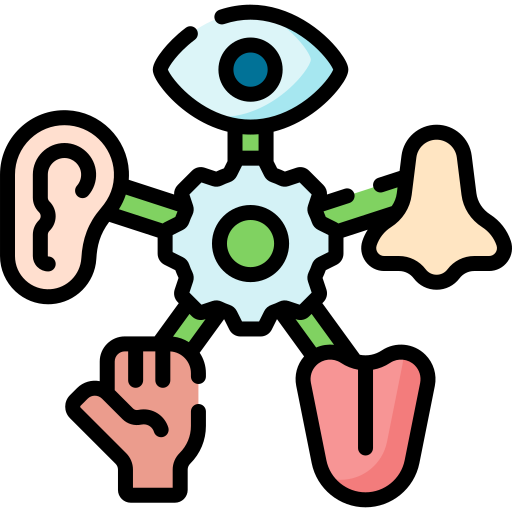
Sensory Processing
Helping children regulate responses to sensory inputs like sound or textures.

Activities of Daily Living
Teaching independence in brushing teeth, dressing and toilet training.

Visual Motor Integration
Developing hand-eye coordination needed for catching a ball or copying words.

Social & Emotional Regulation
Helping kids manage feelings, routines and peer interactions.
Joint Attention and Play
Helping kids develop eye contact and focusing through floor play.

Oral Motor Skills
Helping develop facial expressions and supporting speech development.

Speech Therapy
Pediatric speech therapy focuses on helping children communicate effectively and gain the oral-motor skills needed for eating and drinking.
Unlike adult therapy, pediatric sessions are play-based, using toys and games to make learning natural.
Almost 3/4 th of parents coming for consultation say ‘My child is not speaking’.
At The Play Podd we insist on eye contacts and non-verbal communication as the first step in communication.
Speech is a unique skill that human beings have with the brain processing highly cognitive information.
We focus on improving communication skills and verbal skills through Speech Therapy.
Speech therapy is deeply tied to behaviour in children because the ability to express reduces frustration.
In this joint venture with occupational therapy we resolve oral sensitivity problems and enable oral muscle movements.
Play and Behaviour Therapy
PLAY THERAPY AND BEHAVIOUR THERAPY ARE TWO SIDES OF THE SAME COIN.
While they use different methods, they are frequently combined to help children navigate emotional challenges.
If a child has frequent meltdowns, Behavior Therapy gives tools to stop tantrums while Play Therapy addresses the underlying emotions.
Play therapy provides vent out opportunities for children to express anger or frustration.
Behaviour therapy focuses on emotional healing and self-expression through toys, art and stories.
It helps build life skills, discipline and reshape maladaptive behaviour.
Emotional Healing Therapy
HAPPY PARENT = HAPPY CHILD
With the child being diagnosed with neurodevelopmental conditions, parents often experience emotional trauma and uncertainty.
WE UNDERSTAND THE PARENT’S EMOTIONS and helping them is an important part of completing the circle of treatment.
Healing means developing a larger window of tolerance to navigate emotional storms.
Stages of Emotional Journey

Grieving
Many parents feel guilty for feeling sad but emotional healing begins with acknowledging ambiguous loss.

Acceptance
Accepting reality reduces emotional pain and helps focus on small victories.

Building your community
Connecting with other parents and support groups reduces isolation.

Learning restoration techniques
Taking short and long breaks helps prevent caregiver burnout.

Therapy support for yourself
Individual sessions help parents manage emotional well-being.